
It happened: NVDA announced earnings this week.
- The most famous company in the world.
- Amid a global espionage scandal.
- After a very public exit by the founder, Jensen Huang.
The numbers didn’t disappoint…
Tech stocks have been falling for weeks…
When earnings season began in October, investors gawked at the size of AI spending. A blue-wave midterm sparked fears of a slower AI buildout. Then inflation and the Iran war further cemented a bearish trajectory.
Jensen Huang’s scandalous affair with an alleged Chinese spy increased the length and depth of the selloff.
Then, over the last weekend:
- Users experienced widespread issues with Microsoft Outlook.
- The FAA grounded flights across the entire country.
- And banks experienced technical difficulties.
It’s been one bearish catalyst after another.
But in the next few days, the momentum could reverse. Drastically.
I have a plan to trade the coming tech rally.
The NVDA Earnings
On November 12, Jensen Huang resigned as Nvidia’s CEO, president, and board member after reports of multiple affairs, including one with an alleged Chinese spy.
Longtime CFO Colette Kress stepped in as interim CEO. Former Synopsys CEO Harvey Jones became Nvidia’s first-ever board chair.
And on Tuesday, November 17, the pair hosted their first earnings call. The numbers were massive…
- Adjusted EPS of $2.68 beat by $0.21.
- Revenue of $115.8 billion (+103% year-over-year) beat by $6.65 billion.
- Q4 revenue guidance of $127.4 – $132.6 billion, above the $125.25 billion estimate.
Nvidia also announced a $150 billion stock buyback, reported a $2.5 trillion cloud backlog, and raised its fiscal 2028 revenue growth outlook from 70% to 75%.
But the call itself was a mess.
Jones opened by saying they wouldn’t take questions about Jensen. He also said the board has no plans to bring him back, even though Huang said he’s open to returning.
Eight analysts asked questions. Not one mentioned Jensen. Kress never said his name. And Jones stumbled over his script like it was scrolling too fast.
That’s a problem. Jensen founded Nvidia in 1993 and became the face of the AI revolution. His exit was very public, the effects of which are by no means bedded down. And management that stepped up wants to pretend like he never existed?
Weird… immature even.
NVDA jumped nearly 5% during after-hours trading.
Then reality set in…
On Wednesday, the stock briefly gained 2.7% before reversing. By midday, it was down more than 2%.
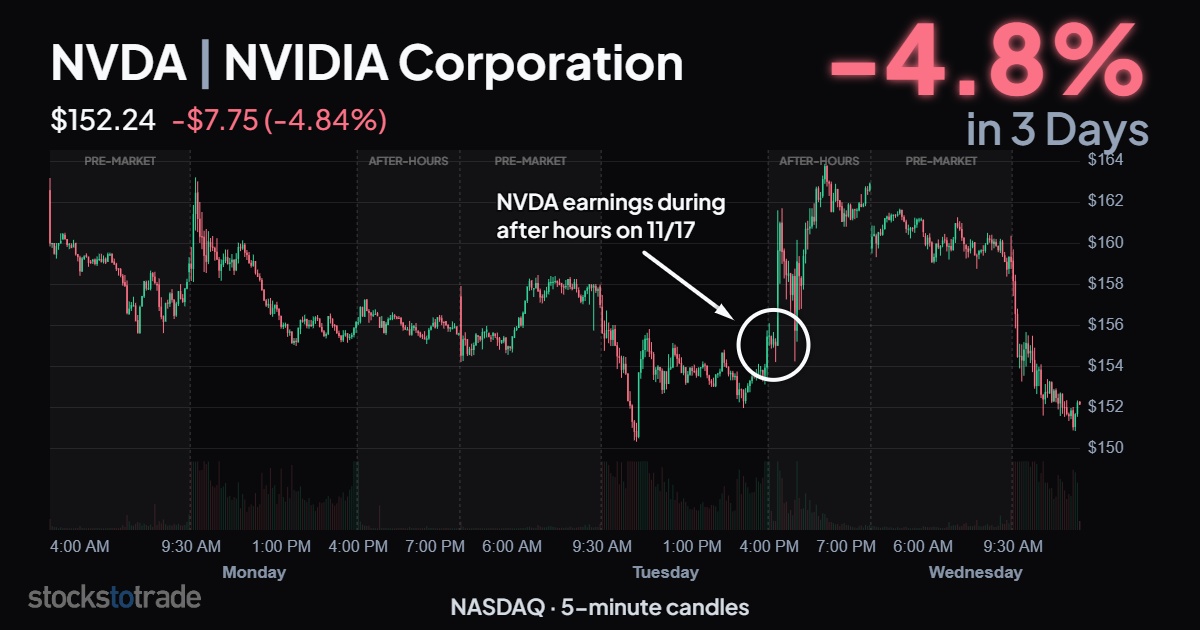
Great numbers bought Nvidia some time. But the leadership question isn’t going away.
My Trade Plan for the Tech Rally
On Tuesday, just hours before NVDA reported, I sent this message to traders:
“Today is IMO the last shakeout before NVDA earnings. We’ve seen some of the most bearish price action in years in semiconductor stocks, many of which are down nearly 50% in 1 month… Moves like these typically end with VIOLENT reversals in my experience.”
I’m positioning for that reversal. And one stock stands out…
Super Micro Computer Inc. (NASDAQ: SMCI) builds servers and data center infrastructure for AI. It’s one of Nvidia’s closest partners. On its November 3 earnings call, management said it was among the first to ship Nvidia’s new Vera Rubin NVL72 racks. AI now makes up about 71% of its revenue.
But you wouldn’t know it from the chart.
On November 12, the day Huang resigned, SMCI fell 11.3% in a single session.
It’s now down nearly 50% from its October highs and trading well below its 50-day moving average.
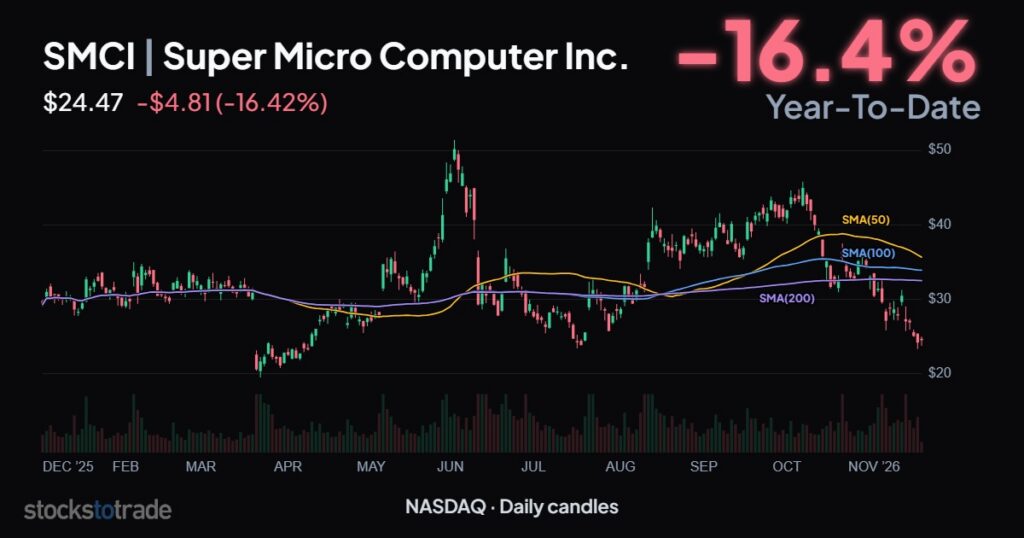
That’s an overextended selloff. And it’s the same kind of reversion trade setup I played on NVDA earlier this month. A stock falls too far, too fast… then snaps back.
Here’s the alert I sent traders on November 17 at 1:22 PM ET:
“BUY SMCI 11/27/26 $24 CALLS… Super Micro is one of, if not the most oversold tech name.”
As of November 18, SMCI is still trading near Tuesday’s levels. There’s still time to get in.
But remember, these contracts expire on November 27, the day after Thanksgiving and a shortened trading day. Short-dated contracts magnify every move, up and down.
So take my advice:
“Trade tight in these tapes. The best defense against losses is your initial trade sizing. Don’t ever go too big too fast.”
Start small. Focus on just a couple of trades at a time. If this reversal comes, it’ll come fast.
Stay Street Smart,
Jeff Zananiri