The ceasefire finally happened.
Military forces in the U.S. and Iran agreed to lay down their weapons for two weeks.
After more than a month of destruction in the Middle East and higher oil prices due to the Hormuz closure, the world can collectively sigh with relief.
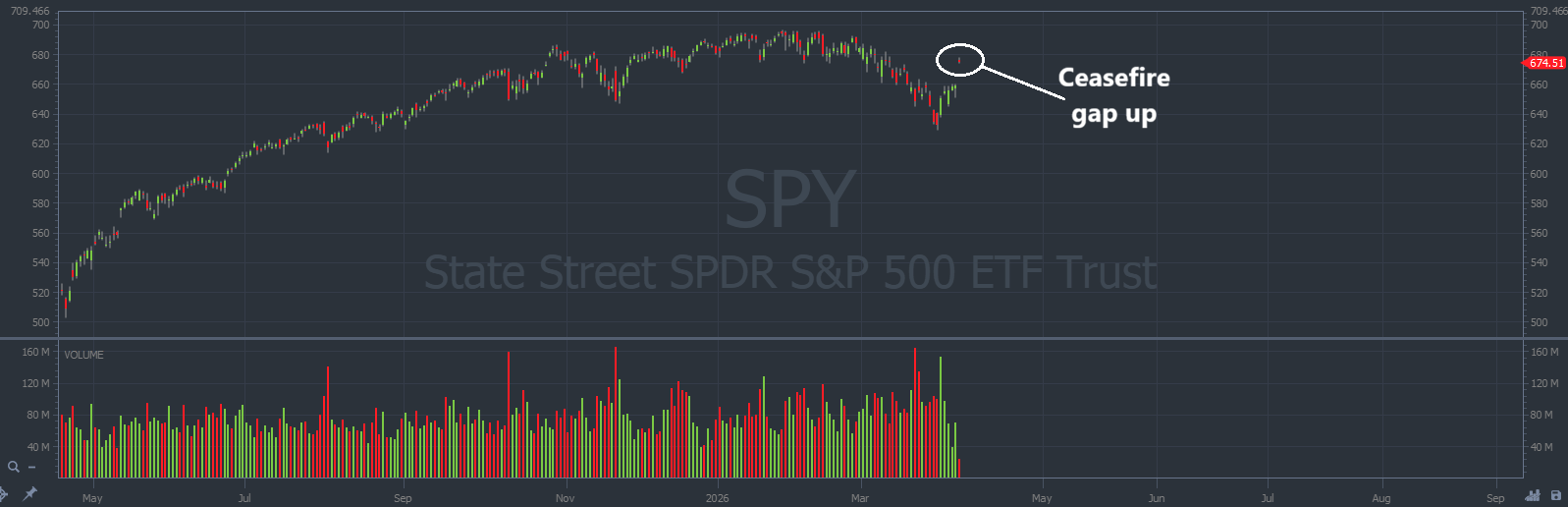
On Wednesday, April 8, the morning after the ceasefire was announced, markets gapped up.
Here’s the S&P 500 ETF Trust (NYSE: SPY):
90% of traders lose money because they have the wrong idea about these catalysts.
Allow me to set things straight.
The Pendulum Swings Again
I’ve traded both sides of this war for weeks.
Some of the best setups have come from oil stocks because of the sector’s vulnerability to the conflict:
- I alerted Puts on Exxon Mobil Corporation (NYSE: XOM) as peace-talk optimism dragged the energy sector lower.
- Then I flipped and traded the rally on Occidental Petroleum Corporation (NYSE: OXY) when the selloff got overextended and Iran denied the peace talks.
Two trades, in opposite directions, from the same sector, and they were both winners.
That’s the Iran catalyst in a nutshell. The war has turned the market into a pendulum.
Peace talks pushed oil prices down. Escalation brought them back up. And the opposite is true for market indexes.
Every swing is a trade opportunity if you know what to look for.
This morning, the pendulum swung hard toward euphoria. As a result, major indexes surged and oil futures plunged.
Trump called it “a big day for World Peace!” on social media, and the crowd went wild.
But I’m not convinced…
Why I’m Skeptical
I want to believe in this ceasefire. But I’ve watched Trump’s track record with big announcements:
- Tariffs
- Trade deals
- Peace talks
His “yes” can flip to a “no” overnight.
And even if the ceasefire lasts, it doesn’t actually fix the core problem.
The Strait of Hormuz was virtually shut down for over a month. About 20% of global oil flows through that waterway, and it was an unreliable passage for an extended period of time.
A ceasefire won’t immediately reverse the effects.
Iran’s foreign minister confirmed that safe passage will require coordination with Iran’s Armed Forces.
And it’s not like every armed group in the region signed the ceasefire…
Israel is still striking Lebanon. Hezbollah is threatening to resume fire if Israel doesn’t hold. Some of the militias in the region don’t care what Tehran agreed to.
Plus, the genie is out of the bottle on Hormuz.
What was once the world’s most reliable energy corridor is now an obvious choke point that can be threatened by whoever.
The risks don’t disappear with a two-week pause.
What Overextended Looks Like
Here’s the thing most traders get wrong in a moment like this.
They see the market spiking, and they think, “I need to get in. I’m missing the move.”
That feeling, the panic of missing out, is exactly what chops up your account.
When the market is euphoric, and everyone is celebrating… that’s when the price gets overextended to the upside. And overextended price action has a way of snapping back.
The same way I buy panic to play the coming bounce, I sell euphoria to play the pullback.
When the market gapped up on Wednesday, I immediately started hunting for Put contracts. I’m not calling for a crash. I’m just being realistic about the market’s initial response.
The catalyst matters. But the chart matters more.
How I’m Positioned Right Now
No matter what, I always have cash on hand.
Whether you’re buying Calls, Puts, or some combination of both…
We need cash on hand to average down if the price is initially uncooperative or if new setups emerge.
Right now, I’m targeting Put contracts as the euphoria continues.
And I’m watching the same index we’ve traded for weeks: the iShares Russell 2000 ETF (NYSE: IWM).
Look at the massive overnight move on this stock:
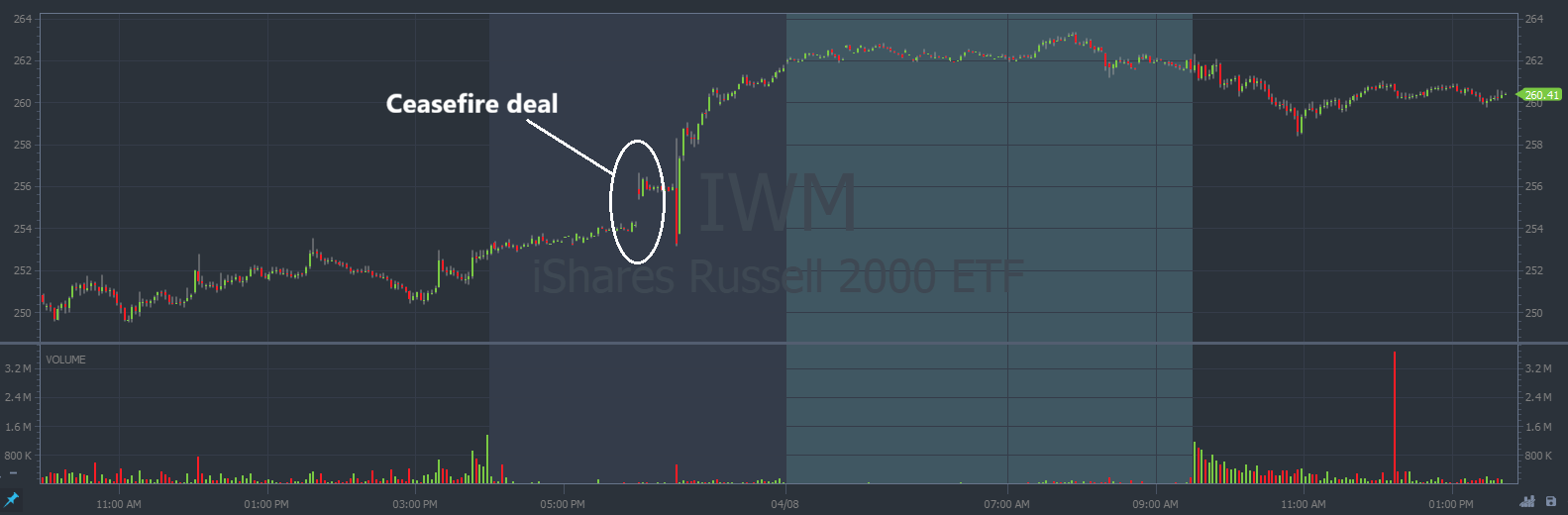
The price action during regular hours already started to pull back on April 8…
The ceasefire might hold. It might fall apart by the weekend. Nobody knows what’s going to happen for sure.
What I do know is: the only way to survive a market like this one is to take your emotions out of the trade.
- I’m buying when everyone is panicking.
- I’m selling when everyone is celebrating.
It might seem backward…
But in a way, that’s exactly how I know it works.
Stay Street Smart,
Jeff Zananiri
*Past performance does not indicate future results, Not typical.