Happy Friday, traders…
Jeff here.
Thursday was a notable day in the stock market…
The Invesco QQQ Trust (NASDAQ: QQQ) — the big-boy tech index — dropped as much as 2.4% intraday in its biggest single-day decline in over three months:
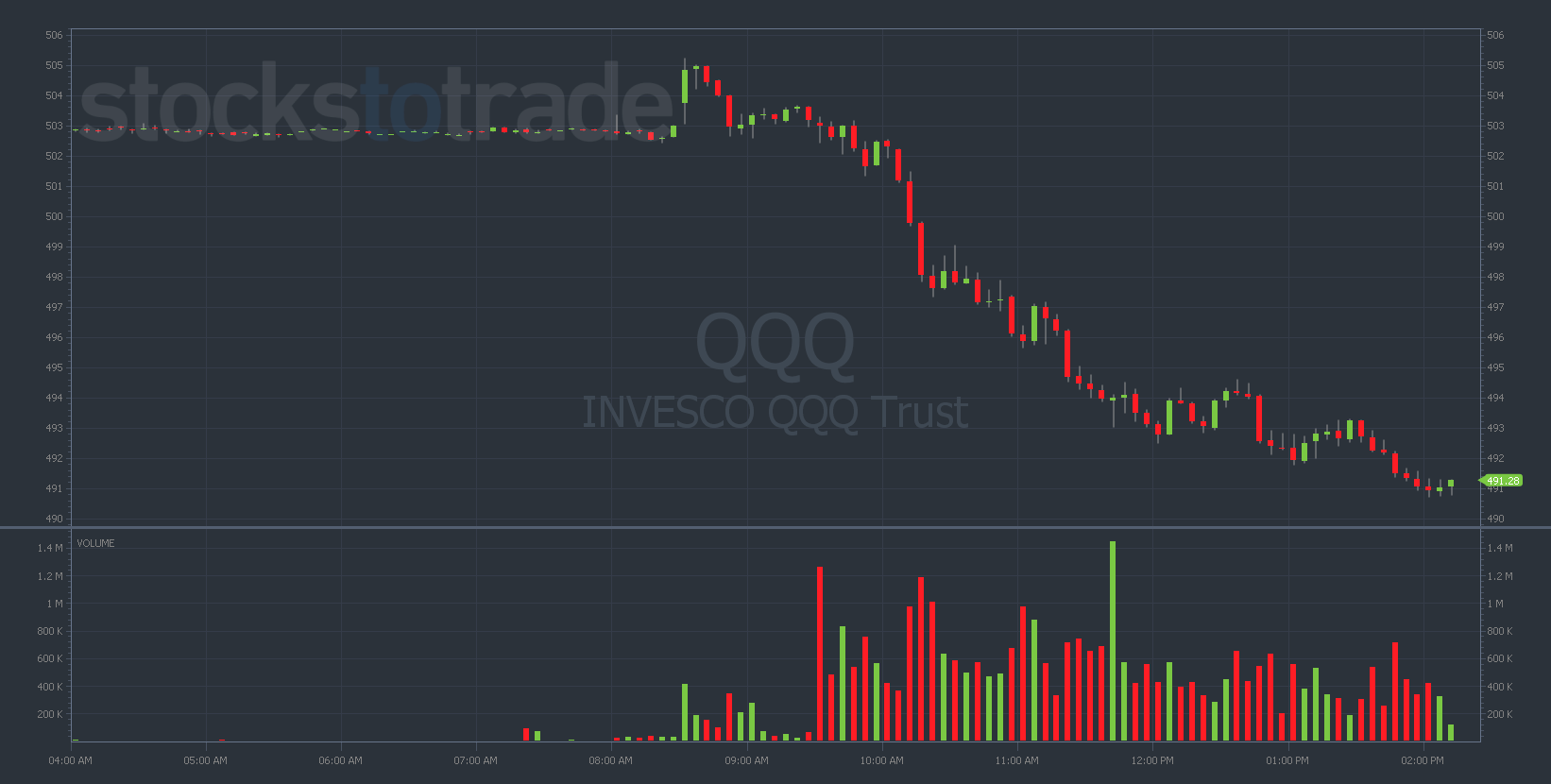
This sell-off followed the June print of the Consumer Price Index (CPI) report — one of The Federal Reserve’s favorite inflation gauges.
Interestingly, the report brought good news on the inflation front:
- The CPI declined 0.1% from May, putting the 12-month inflation rate at 3% (near its lowest level in over three years).
- Excluding volatile food and energy costs, the “core CPI” increased 0.1% monthly and 3.3% from a year ago (the smallest rise since April 2021).
- A 3.8% drop in gas prices dampened inflation for the month, offsetting 0.2% increases in both food and shelter prices.
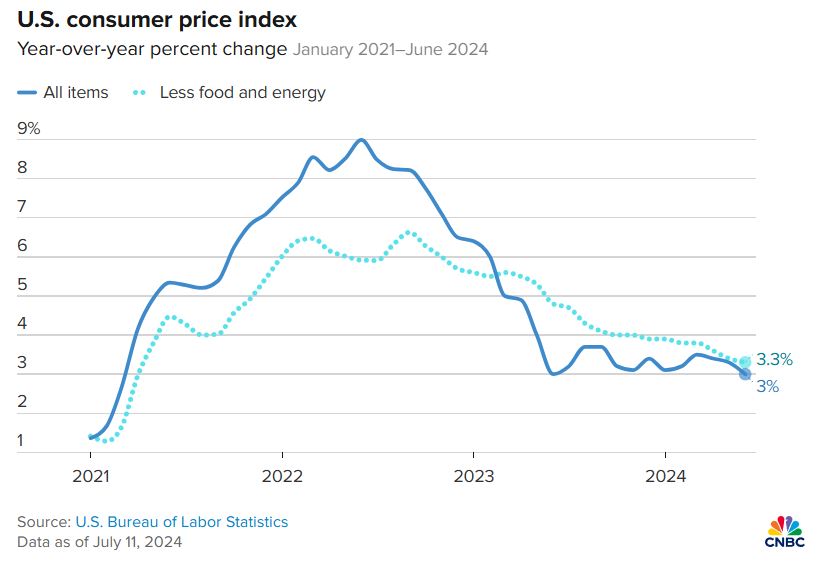
Despite the CPI moving in the right direction, tech stocks tanked.
If you think price action is atypical, you’re right. But it was how stocks sold off that really piqued my interest (more on that later).
Many traders are still scratching their heads, wondering what the heck happened yesterday.
And that’s why I’m here to help…
Based on 25 years of trading experience, much of it on Wall Street, I have a few ideas as to what’s going on in the market right now (and predictions for the near future)…
Why Tech Stocks Reversed
Identifying a single reason “why” something happens in the stock market is impossible.
But when it comes to yesterday’s tech sell-off, I have some theories. And most of them come back to interest rates.
I’ve been warning students that a rate cut could trigger a counterintuitive market downturn.
The rate cut has been priced in all year. Analysts initially thought it would happen in March, then June, and recently, the timeline has been moved out to the fall.
Now, when the cut actually occurs, it won’t be surprising. Everyone and their grandma is expecting it.
It’s like an earnings report with a huge implied move already priced in.
I think the sell-off this week was front-running that potentially larger future drop when a cut happens.
Thursday’s CPI report gave the Fed serious ammunition for a rate cut, causing traders to position themselves for such an event.
Additionally, it’s not surprising anymore to see inflation cooling off. Inflation has been on a downward trajectory since mid-2022.
But even more important than the “why” is the “how.” And how stocks sold off on Thursday caught my attention.
Why The Sell-off Was So Orderly
Following QQQ’s 25% surge in the first half of 2024, I would expect the first big red day to be extremely volatile, with traders filled with fear leading to a limit-down circuit breaker.
But Thursday’s sell-off was very orderly. No huge VIX spike, no double-digit drops in individual stocks, and no 5-7% haircut in the indexes.
So, why aren’t we seeing more fear in the markets?
To answer this, let’s rewind to some recent history:
2022 was the worst year for stocks since 2008, with the QQQ returning a dismal -32.8%.
There were plenty of red days to be wary of throughout 2022, but most were missing one thing — a huge spike in the CBOE Volatility Index (VIX).
Volatility was surprisingly muted throughout the second half of 2022.
Theories range as to why, with the most common being that the bad news in 2022 wasn’t particularly surprising.
For the VIX to spike hard, there needs to be a shocking negative catalyst.
But most of the negative catalysts in 2022 were expected (or outright foreseen).
Example: A lot of smart market analysts predicted an increase in inflation and thus, interest rates, prior to the actual policy changes.
Sound familiar? I think a similar phenomenon is happening right now. The news isn’t surprising at all.
And even though a sell-off following a good inflation print may seem surprising, it’s really not when you zoom out and see how unbelievably overextended the market is right now.
The CNN Fear and Greed Index is currently sitting at “Neutral”…
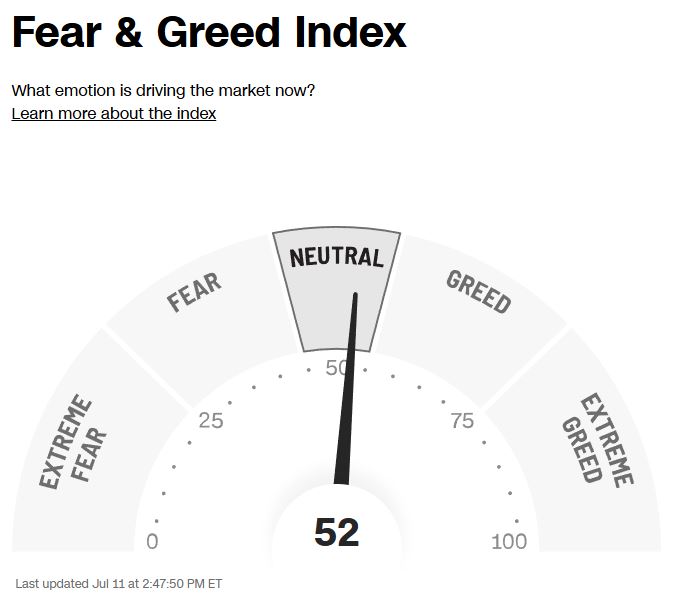
Without a major surprise, we don’t get volatility. And make no mistake, as options traders, we want volatility.
So, let’s watch the market closely over the next week to see if this bearishness capitulates into more fear, or if the indexes get bought right back up again on Monday, just like they have after nearly every other red day this year.
For now, nothing is broken and everything is orderly. And it’ll take more than that for me to believe this AI bubble is truly popping … for good.
Happy trading,
Jeff Zananiri