The next two weeks will reshape the entire market.
Three catalysts are hitting Wall Street around the same time. And each one carries enough weight to swing major indexes.
That kind of volatility means there’s money up for grabs.
Here’s what I’m watching…

These are the three biggest catalysts in the market:
- NVIDIA Corporation (NASDAQ: NVDA) just reported earnings.
- Elon Musk’s SpaceX filed for an IPO.
- And the Iran situation refuses to resolve, no matter how many headlines talk about a deal.
Each of these catalysts alone has the potential to inspire unusual volatility in the market. But the fact that they’re all hitting at the same time…
Pay attention. These market moves will be huge.
Catalyst #1: The NVDA Earnings Read-Through
NVDA dropped Q1 numbers after the close on May 20.
The headlines were massive.
- Revenue of $81.6 billion, up 85% year-over-year.
- Profit of $58.3 billion, up 211% from last year.
- Data center revenue of $75 billion, up 92% year-over-year.
- Next-quarter guide of $91 billion, ahead of the $86 billion consensus.
The biggest nominal single-quarter profit ever recorded by any company in the history of the world.
On paper, those numbers should have sent the stock ripping in after-hours trading.
Instead, NVDA fell 1% after the report.
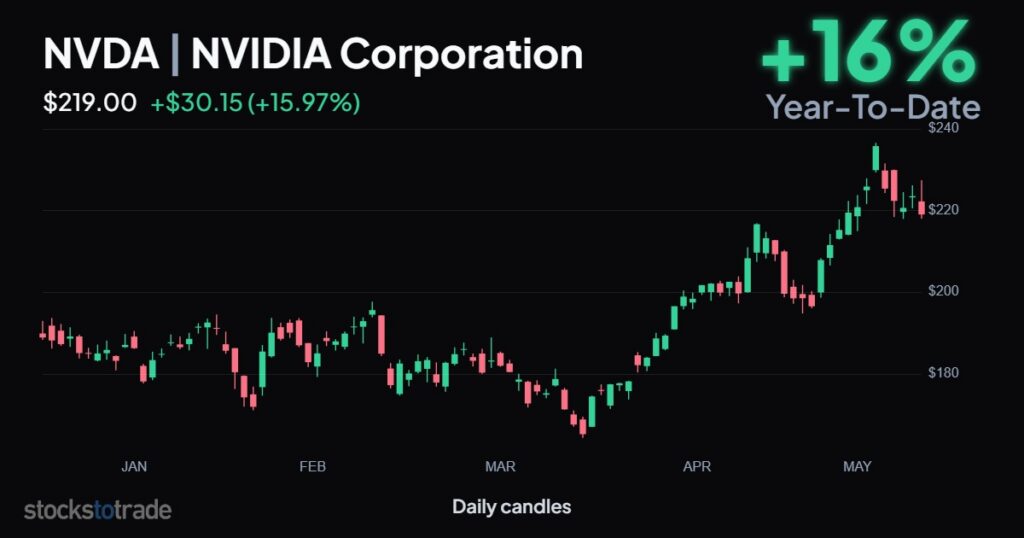
What happened?
Investors are used to NVDA’s big earnings beats.
NVDA also announced a buyback and a dividend. In my experience, mature, slower-growth companies use buybacks and dividends to attract capital. That’s not the playbook for a company growing revenue 85% per year.
It’s a tell.
Jensen Huang said demand has “gone parabolic.” But smart money reads moves like this and asks whether the parabolic phase is closer to the top than the bottom.
Watch how NVDA trades the rest of this week. The early weakness already gave us a clue. Let’s see if the trend holds.
Catalyst #2: The SpaceX IPO Drag
Elon Musk’s SpaceX just filed to go public on the Nasdaq under the ticker SPCX.
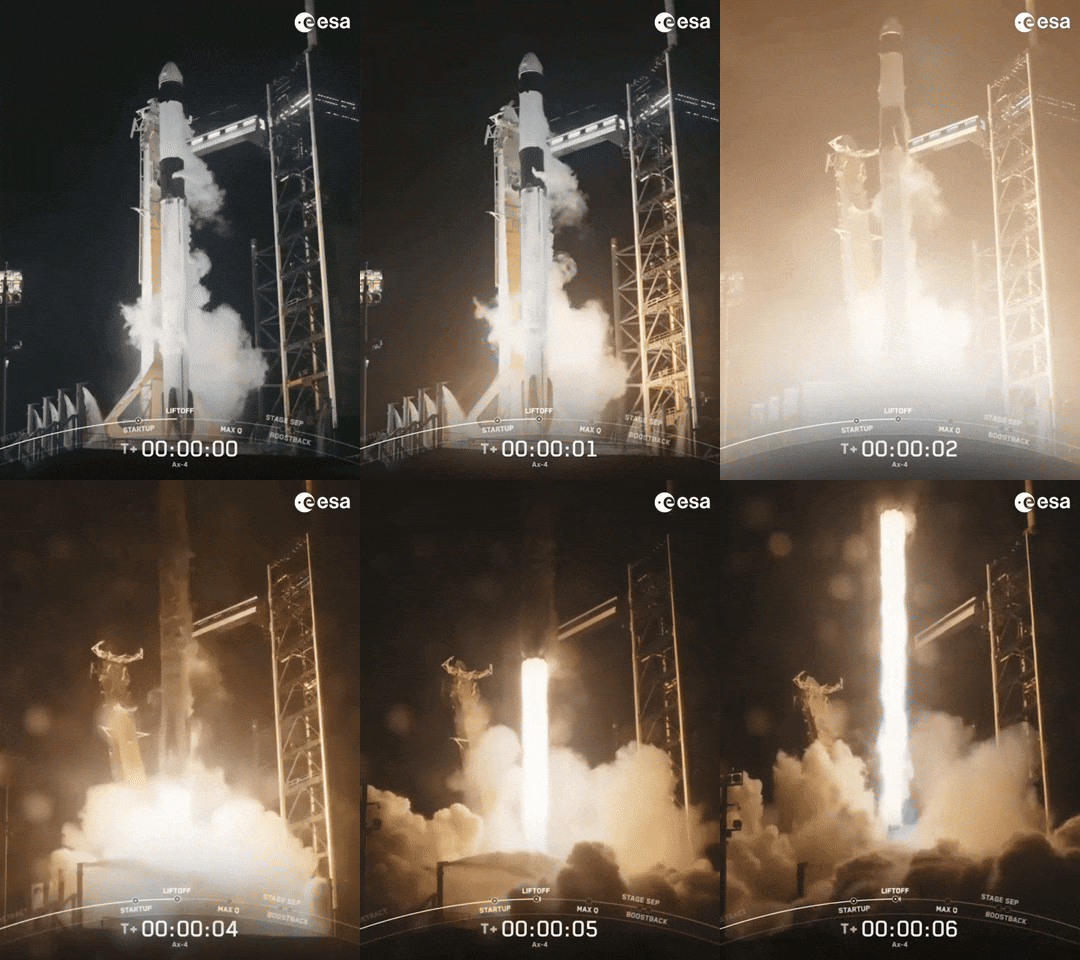
The roadshow starts June 8. And retail investors will get direct access through Robinhood, Fidelity, and Charles Schwab at the same price as institutions.
That last part is unprecedented for a deal this size. SpaceX is one of the most valuable private companies on the planet. And usually, insiders get first dibs when a company that big goes public.
Here’s an interesting aspect that relates to NVDA: when a mega-cap tech IPO hits the calendar, fund managers don’t print new money to buy the shares. They sell existing positions to make room for the allocation.
A portfolio manager building a SpaceX position could be trimming NVDA, Microsoft Corporation (NASDAQ: MSFT), Alphabet Inc. (NASDAQ: GOOGL), and the rest of the big-tech bench.
It’s a potential net drag on the market that nobody talks about until after the fact…
Combine that with NVDA’s muted post-earnings reaction, and you have two signals pointing at the same conclusion. The big-tech tape is heavy.
Catalyst #3: The Iran Situation Isn’t Resolving
On Wednesday, May 20, President Trump said that negotiations with Iran are in the “final stages.”
The announcement caused West Texas Intermediate to drop more than 5%. Brent prices fell as well.
The market priced in a peace deal: headline-chasers bought the dip in equities and sold their oil exposure.
I disagree with the consensus here.

- Iran still believes it has the right to enrich uranium.
- Iran still operates as if it controls the Strait of Hormuz.
- Washington’s position on both points is the exact opposite.
Citibank told clients this week that the market is underpricing the risk of a long Hormuz disruption. The bank sees Brent trading up to $120 in the near term if flows stay blocked.
Wood Mackenzie published an even more aggressive scenario. If Hormuz stays closed through year-end, oil approaches $200 per barrel.
I’m not predicting $200 oil, or a war that lasts into 2027… I’m pointing out that the market is pricing in the best outcome and ignoring the realistic one.
Every time the “deal is close” headline hits, traders cover oil shorts and chase equity rebounds. And every time talks stall, the moves reverse.
It’s volatility in both directions due to an indecisive international policy.
How I’m Trading This Tape
When the market is digesting this much news at once, forcing a directional bet is the worst thing you can do.
The market will tell us which catalyst is winning each session.
- When NVDA leads, the indexes follow.
- When oil rips higher on a failed deal, energy outperforms and tech lags.
- When the SpaceX roadshow ramps up, big-tech weakness could continue.
These three catalysts are massive and all over the news. But the traders who get hurt in situations like this swing at every headline.
Instead, let the chart confirm a direction before you commit capital.
Learn my entire trading process all at once.
We’re finding trade setups in both directions thanks to this volatility.
Get ready…
Stay Street Smart,
Jeff Zananiri
*Past performance does not indicate future results, Not typical.