What if I told you that your trade plan is perfect? You just need to follow it.
I trust a specific trade plan with my whole heart…
And my confidence in the strategy keeps me cool as a cucumber while I wait for gains.

I always hear from traders that they took a big loss because their trade plan “failed”.
But when I dig deeper, I realize they stopped following their plan entirely.
- The setup was good.
- The trade strategy was good.
- But they couldn’t stick to the rules.
My students and I just locked in gains from a trade that looked like it was falling apart. And anyone who took early losses forfeited their share of the winnings…
Because after a few days, the stock did exactly what I wanted it to.
The GameStop Bid That Wasn’t
On May 3, GameStop Corp. (NYSE: GME) dropped a bombshell on Wall Street.
Ryan Cohen’s company submitted an unsolicited, non-binding offer to acquire eBay Inc. (NASDAQ: EBAY) at $125 per share.
The proposal was 50% cash and 50% GameStop common stock, representing a 46% premium to EBAY’s closing price from February 4, when GameStop started accumulating shares
The market reaction was instant.
EBAY ripped higher on the news as traders piled in chasing the deal premium.
The thinking was simple: if GameStop is willing to pay $125 per share, the stock should trade somewhere close to that number (it was trading at $104 when the news dropped).
Then, on May 12, EBAY’s Board of Directors rejected the proposal outright. The official response letter to Ryan Cohen called the offer “neither credible nor attractive.”
The Board cited concerns about GameStop’s financing, EBAY’s standalone prospects, and the value of accepting GameStop stock as half the consideration.
And just like that, the catalyst was dead.
Why I Called Puts On EBAY
Here’s the setup I saw on May 15…
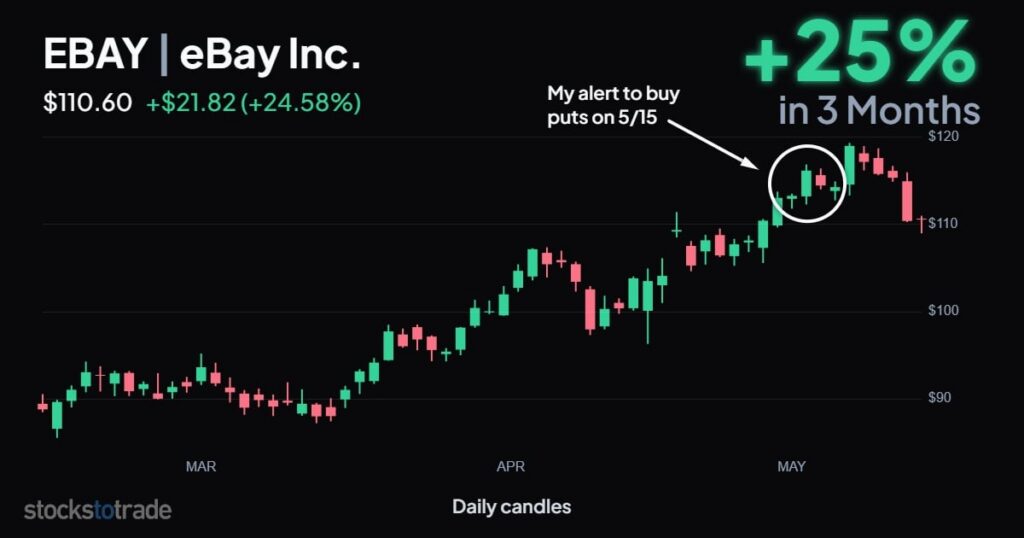
EBAY spiked on the GameStop bid. The stock was trading around $115 after the catalyst evaporated.
Logic said the premium should bleed out of the stock now that the deal was off the table. There was no reason for EBAY to hold its new level.
I alerted my students to buy the June 18 $105 puts:

The thesis was straightforward:
- The catalyst that drove EBAY higher was officially dead.
- Wall Street was still digesting the rejection.
- The stock was ready to move lower as the speculative money rotated out.
But the script doesn’t always play out on day one…
When The Trade Looked Like It Failed
Here’s what nobody tells you about catalyst trades:
The market doesn’t care about your timeline.
After my alert went out, EBAY didn’t immediately roll over. The stock chopped sideways. It even ticked higher for a couple of sessions.
The $105 Puts dropped in value, and my position showed an unrealized loss.
This is the moment where most traders blow up their own trades.
They see a 20% drawdown on the contract value and panic. A few hours later, a 50% drawdown causes them to cut the position to “protect what’s left.”
They convince themselves the trade is broken when really, the catalyst hasn’t played out yet.
The setup was still intact. The thesis was still valid. The only thing that changed was the unrealized number on the screen.
The Drawdown Math Every Options Trader Needs
Options positions move differently from stock positions.
A 50% unrealized loss on a put contract sounds catastrophic if you’re used to thinking in equity terms. A 50% drop in a stock’s price requires a 100% rally to break even.
But a 50% drop on an options contract can reverse in a single session.
My trade positions regularly gain 100% or more when the thesis plays out. The flip side is that the short-term swings are sharper in both directions. A position can be down 50% on Tuesday and finish up 60% by Wednesday.
If you cut every time you see red, you cap your upside at zero while keeping all the downside.
That’s the worst risk/reward in trading.
I’m not saying hold every losing trade forever. If a stock breaks the thesis, if the chart crosses your stop loss level, cut it.
But don’t cut a healthy setup just because the screen shows red.
The EBAY chart was still in the range I expected. And look what happened next…
The Payoff
EBAY eventually rolled over.
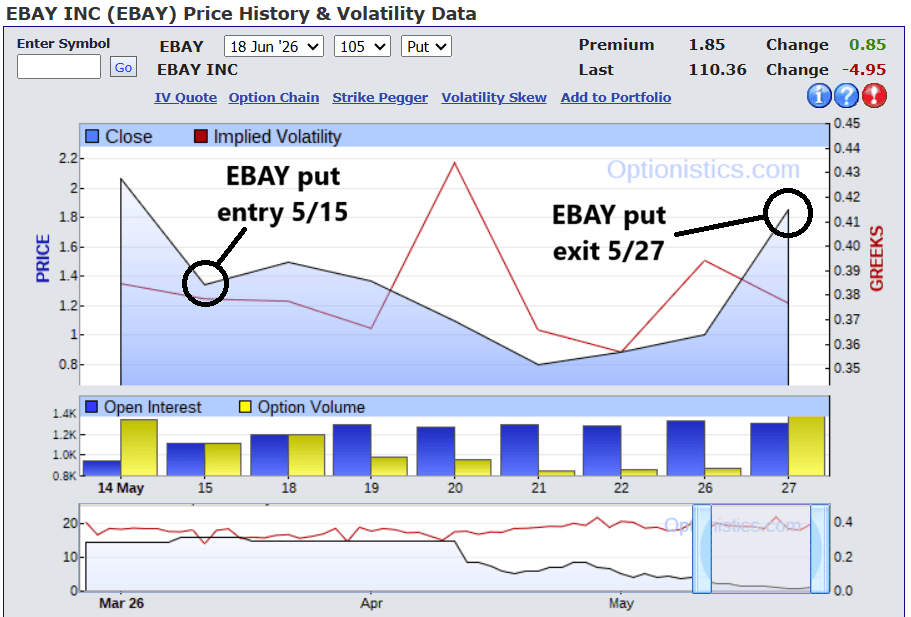
By May 27, EBAY broke below the level I bought at.
The June 18 $105 Puts that I alerted were trading in the green. That’s when my students and I locked in the gains.

Here’s a look at the change in value of my contracts:
The traders who cut early on the drawdown? They watched their losing trade turn into a winner.
I can only imagine that feeling…

That’s the cost of breaking your own rules.
Patience Is The Edge
The hardest part of trading isn’t finding setups, reading charts, or picking strikes and expirations…
The hardest part is sitting through the noise between entry and exit while the position moves against you.
Every drawdown feels permanent in the moment. Every red day feels like proof you were wrong.
The traders who win learn to separate their thesis from the immediate value of their position.
Trust the plan you built before emotions entered the picture.
Trust the process that I used to turn $5,000 into $493,000…
There IS a science to this.
Stay Street Smart,
Jeff Zananiri