The talking heads agree…
Goldman Sachs’ Chairman and CEO, David Solomon, said something this week that confirms my early suspicions about the market, as it relates to the war in Iran.
And I’ve already used this information to trade.
Solomon: “I’m actually surprised. I think the market reaction has been more benign, given the magnitude of this, than you might think.”
He’s right to be surprised.
This is where we’re at:
- A U.S. submarine sank an Iranian warship in the Indian Ocean.
- NATO air defense systems shot down an Iranian missile heading toward Turkey’s airspace.
- The chairman of the Joint Chiefs of Staff said the U.S. will start “striking progressively deeper” into Iran.
- Defense Secretary Hegseth called this “very early” in military operations.
- More than 1,000 people have been killed in the war since Saturday.
All that chaos, and after three trading days, the S&P 500 ETF Trust (NYSE: SPY) is trading back at the pre-war levels from Friday, February 27.
I wrote about this on March 3… I said the market was too calm.
Now we have a widening war and a Wall Street CEO (among others) publicly expressing surprise at how little the market has reacted.
This is an eerie calm.
I have a plan for what comes next.
Sometimes, No Trade IS The Trade
On March 3, as the market rebounded off new 2026 lows, I sent my students a single alert:

I know what some of you were thinking…
The market was moving. Oil was surging. Defense stocks were volatile. There was money to be made somewhere, right?
Maybe. But chasing setups that aren’t clean is how traders blow up accounts.
I see it in the chat every single day. Some of you want to throw money at anything that moves.
War breaks out? Buy defense. Oil spikes? Buy energy. Market drops? Buy Puts on everything.
It’s pure degenerate gambling dressed up as trading.
That’s not a strategy.
The traders who last aren’t the ones who trade the most. They’re the ones who know when to sit on their hands.
Cash is a position.
Goldman’s CEO said it himself: the markets need “a couple of weeks” to digest the implications of this war. The picture is still forming.
Those who force trades into unresolved macro chaos will eventually give their capital to someone with more patience.
My rule is simple: if the price action doesn’t make sense, there is no trade. Full stop.
The setup will come. Wait for it.
The Ticker I’m Watching: IWM
Here’s where my attention is right now.
The iShares Russell 2000 ETF (NYSE: IWM) tracks small-cap stocks. And it was already shaping up to be one of the most volatile tickers of 2026 before a single missile was fired at Iran.
Here’s why:
Big-tech valuations are still stretched this year. A lot of institutional money was already rotating into or out of small-caps.
Then the war started.
Now layer on top: oil prices threatening $100 per barrel, Treasury yields rising instead of falling, inflation risks reigniting, and a conflict that is reportedly still in its early stages…
There’s more volatility ahead.
The IWM barely dipped with the rest of the market alongside the Iran news. And the confusing price action kept me away from a potential trade on March 3.
But this isn’t over…
Here’s the multi-day chart of IWM as of March 4. It’s consolidating just below all-time highs:
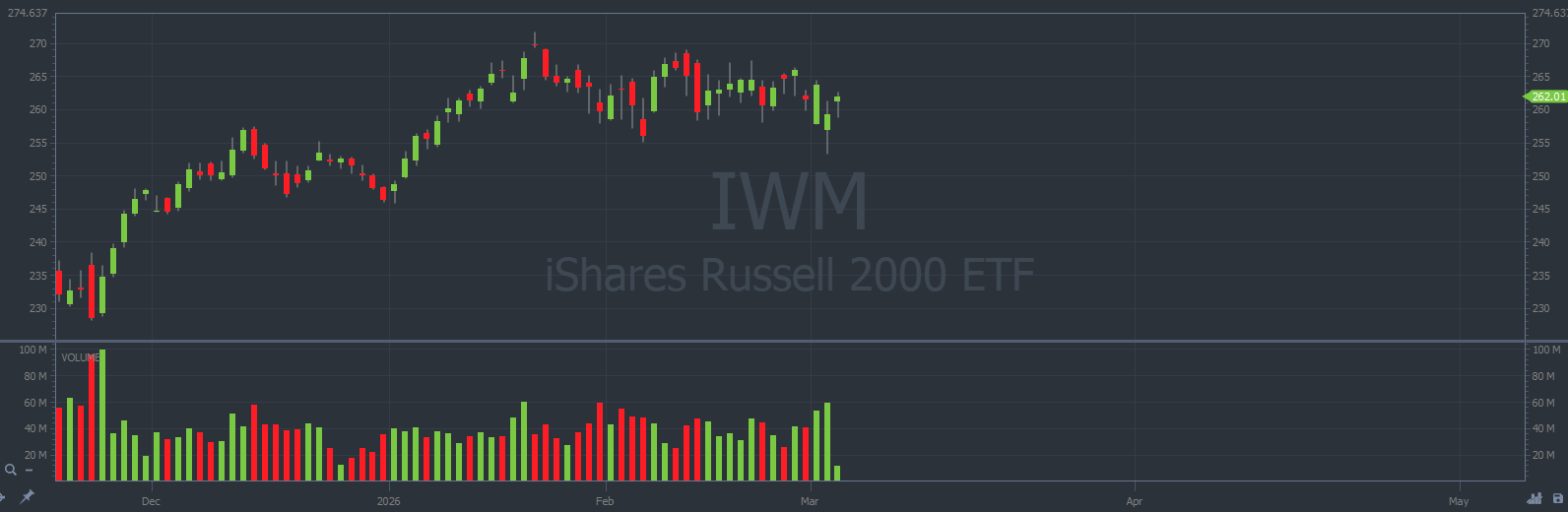
This index is at the top of my watchlist.
When the setup develops, I’ll send you the alert.
Until then: study the chart. Know your levels. And be ready to move when the volatility strikes.
Stay Street Smart,
Jeff Zananiri
*Past performance does not indicate future results, Not typical.