This email is a little different from what usually lands in your inbox…
- No chart today.
- No stock pick.
- No options contract.
Today I want to talk about a bet I made on a basketball game…
Excuse me, a bet I made on THE basketball game.

The NBA finals are finally here. And it’s the New York Knicks versus the San Antonio Spurs.
I know, we usually talk about stock trading here… but I’m also a seasoned gambler. It might surprise you to learn that my strategies are very similar across the two markets
There are tons of ways to make money in this world. Stocks, options, real estate, a contract on who wins a championship… the asset vehicle changes, but my process doesn’t.
When the same setup I hunt in the market shows up somewhere else, I’m not going to ignore it just because it’s wearing a basketball jersey.
That’s leaving money on the table. And I don’t leave money on the table.
Let’s talk about the biggest game in basketball, and how it relates to stock trading…
New York vs San Antonio
Eighty-two regular-season games…
Four rounds of playoff war…
Two cities that have waited all year for this…
And it all comes down to a best-of-seven series for the trophy.
There’s a lot on the line. Pride, legacy, a championship… and for me, money.
I’ve got skin in this game.
I Bet on the Knicks
Here’s the position:
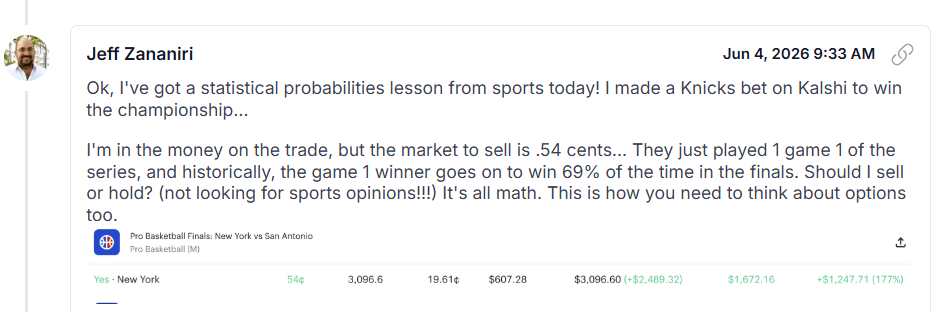
I paid an average of 19.61¢ per contract for 3,096.6 contracts. That’s about $607 of total risk.
The contracts are simple. If the Knicks win it all, each one pays out $1. If they don’t, each one is worth nothing. $0. Similar to options contracts…
The Knicks just took Game 1 of the series. And the contracts I bought for 19.61¢ are now bid at 54¢.
If I sell right now, I collect $1,672 and walk away with a clean win. If I hold and the Knicks finish the job, the position is worth $3,096, a profit of nearly $2,500 on my $607.
So here’s the question I had to answer this morning…
Do I sell the 54¢ and bank it? Or do I hold for the full dollar?
This is not a sports question. I’m not asking whether you like the Knicks. I don’t care about your bracket.
This is a math question. The same math I run on every options trade.
It’s All Math
That 54¢ price tag isn’t random.
It’s the market telling me, in plain numbers, that it thinks the Knicks have a 54% chance of winning the championship.
That’s all a price ever is: a probability with a dollar sign on it.
My job is to figure out whether that probability is correct…
So I pulled the history. When a team wins Game 1 of the Finals, they go on to win the series about 69% of the time. The Knicks won Game 1. So the real probability sits closer to 69%, not 54%.
Now let’s run the numbers on holding:
A 69% shot at $1 is worth 69¢. (0.69 × $1 = $0.69.)
The market wants to pay me 54¢ to take the position off my hands.
69¢ is worth more than 54¢.
The market is offering to buy something from me for less than its worth. Why on earth would I sell it to them? That 15-cent gap is the edge. Same as an option priced cheaper than the real odds of the move.
Don’t give a mispriced contract back to the crowd at a discount just because you’re nervous.
Forget What You Paid
Here’s the part that trips people up.
I bought these at 19.61¢. I’m sitting on a fat gain. Every instinct screams, “Take the money!”
That instinct is the enemy, and it’s how the market wants you to react.
What I paid is a sunk cost. It’s history. It has nothing to do with whether I should hold from here. The only two numbers that matter right now are the price I can sell at (54¢) and the probability this position hits my goal happens (69%).
This is the exact same mistake I watch traders make with options every week.
They get green on a position and bail early. Not because the setup changed, but because they’re scared to give a winner back.
They cap their upside at “whatever I’m up right now” and call it discipline.
It isn’t discipline. It’s fear wearing discipline’s jacket.
Discipline is holding a position that the math says is still cheap, even when your gut wants to grab the cash and run.
The Same Science, Every Time
This is exactly how I trade options.
I’m not guessing tops and bottoms on a whim. I’m measuring the gap between what something costs and what the odds say it’s worth, then taking the setups where that gap pays me.
A basketball contract and a put option are the same under the hood.
Price is a probability. Your edge is the difference between the market’s number and the real one. Everything else is noise.
Stay Street Smart,
Jeff Zananiri
*Past performance does not indicate future results, Not typical.